

Veterinary Breathing Circuits
Breathing circuits deliver precision, safety, and convenience for both pediatric and adult patients. Leak-tested, kink-resistant, and designed for smooth anesthesia flow, they help veterinary staff focus on what matters most successful procedure
What is a veterinary breathing circuit?
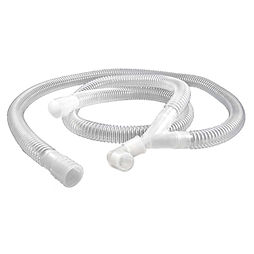
A veterinary breathing circuit is the system of tubing and connectors that carries anesthetic gas from the anesthesia machine to the patient and routes exhaled gas away. It is one of the most critical components of any anesthetic setup — responsible for delivering precise gas concentrations, removing exhaled carbon dioxide, and allowing the veterinary team to assist or control ventilation throughout a procedure.
A properly selected and maintained breathing circuit directly affects patient safety, anesthetic efficiency, and the ability to respond quickly if anesthesia depth needs to change.
Rebreathing vs. non-rebreathing circuits
Veterinary breathing circuits fall into two broad categories, each suited to different patient sizes and procedural needs.
Rebreathing circuits — also called circle systems — recirculate exhaled gas back to the patient after CO₂ has been removed by a soda lime canister. Because fresh gas flow requirements are lower, rebreathing circuits are more economical and help preserve body temperature and airway moisture. They are the standard choice for larger patients and longer procedures.
Non-rebreathing circuits, such as the Bain coaxial circuit, eliminate all exhaled gas without recirculation. They require higher fresh gas flows but offer minimal resistance and allow rapid changes in anesthetic depth — making them especially well-suited for smaller patients where the work of breathing through a circuit must be kept as low as possible.
Choosing the right circuit size: adult vs. pediatric
Circuit size selection is one of the most common questions in veterinary anesthesia. While body weight is a helpful starting point, it is not the only factor. The key consideration is the volume of the circuit relative to the patient's tidal volume — if the circuit volume is too large, anesthetic depth changes slowly; if too small, resistance may increase the work of breathing.
As a general guide, pediatric breathing circuits are used for smaller patients where minimizing dead space and resistance is a priority. Adult circuits are used for larger patients where circuit volume is less of a concern and longer tubing may be needed. When in doubt, consider the procedure length, the patient's respiratory capacity, and whether the patient will breathe spontaneously or be mechanically ventilated.
Our selection includes adult and pediatric unilimb circuits, Bain coaxial circuits, standard adult and pediatric breathing circuits, and Y-connectors — giving your practice the flexibility to match every patient to the right system. Pair your circuit with one of our breathing bags for a complete setup, or explore our full range of anesthesia equipment and non-rebreathing systems.
Built for veterinary practice
Every A.M. Bickford veterinary breathing circuit is leak-tested before it leaves our facility. Our circuits feature kink-resistant tubing, secure luer-lock and 22mm standard fittings, and materials selected for smooth, unobstructed gas flow. Whether you're running a routine dental or a complex soft tissue procedure, you can focus on the patient — not the equipment.



Frequently asked questions about veterinary breathing circuits
What is the difference between a Bain circuit and a circle breathing circuit?
A Bain circuit is a coaxial non-rebreathing system where fresh gas flows through an inner tube, and exhaled gas exits through the outer tube. It requires higher fresh gas flows but has minimal resistance, making it a popular choice for smaller patients. A circle breathing circuit is a rebreathing system that uses a CO₂ absorber and unidirectional valves to recirculate gas, operating efficiently at lower flow rates and working best for larger patients or longer anesthetic events.
What size breathing circuit should I use for a cat or small dog?
For cats and small dogs, a pediatric breathing circuit or a non-rebreathing system like the Bain circuit is typically preferred. The smaller internal volume reduces dead space and lowers resistance, making it easier for a small patient to breathe spontaneously. Patient weight alone should not be the deciding factor — consider tidal volume, procedure length, and whether you will be providing mechanical ventilation.
How often should veterinary breathing circuits be replaced?
Disposable breathing circuits should be replaced between patients according to your clinic's infection control protocol. Reusable circuits should be inspected before each use for cracks, discoloration, loss of elasticity, or compromised fittings, and replaced at the first sign of wear. Always follow the manufacturer's guidance and your practice's anesthesia protocol.
Can I use an adult breathing circuit for a small patient?
Using an adult circuit on a very small patient can increase dead space and slow the delivery of anesthetic gas changes because the larger circuit volume takes longer to equilibrate. For optimal anesthesia management in small patients, a pediatric circuit or non-rebreathing system is recommended.
What are the components of a veterinary breathing circuit?
A standard veterinary anesthesia breathing circuit includes inspiratory and expiratory corrugated tubing, a Y-piece connector that attaches to the endotracheal tube, and ports for connection to the anesthesia machine. In a circle rebreathing system, the circuit works together with a CO₂ absorber canister, a pop-off (APL) valve, a breathing bag, and unidirectional valves. Non-rebreathing circuits like the Bain have a simpler coaxial design.
Do A.M. Bickford breathing circuits work with all anesthesia machines?
Our circuits use standard 22mm fittings compatible with the vast majority of veterinary anesthesia machines. If you have questions about compatibility with a specific machine, contact our team at (800) 795-3062 and we'll confirm before you order.